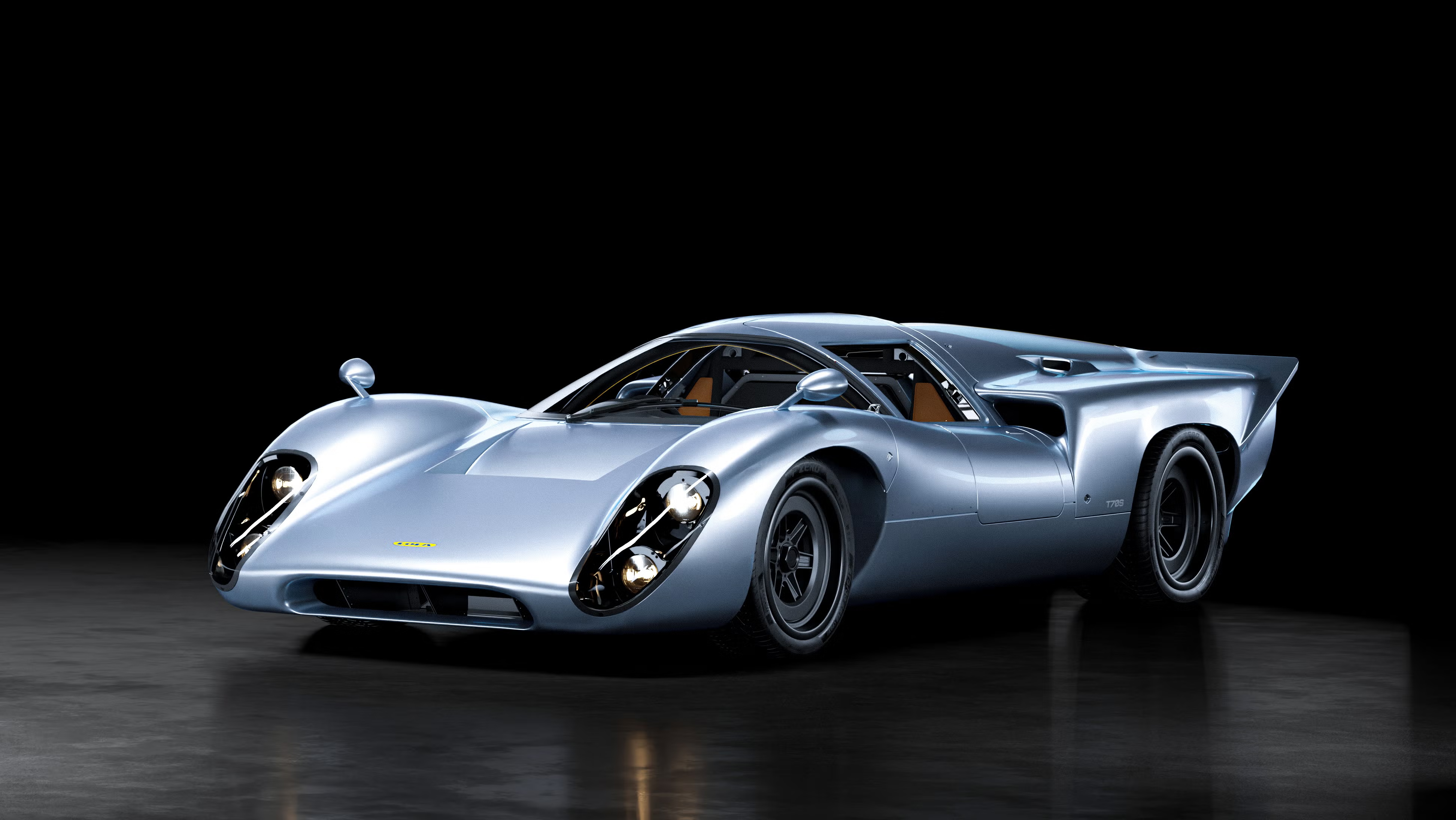
The Lola T70 Is Back. 500 HP, 890 KG, and a Body Made From Plants.
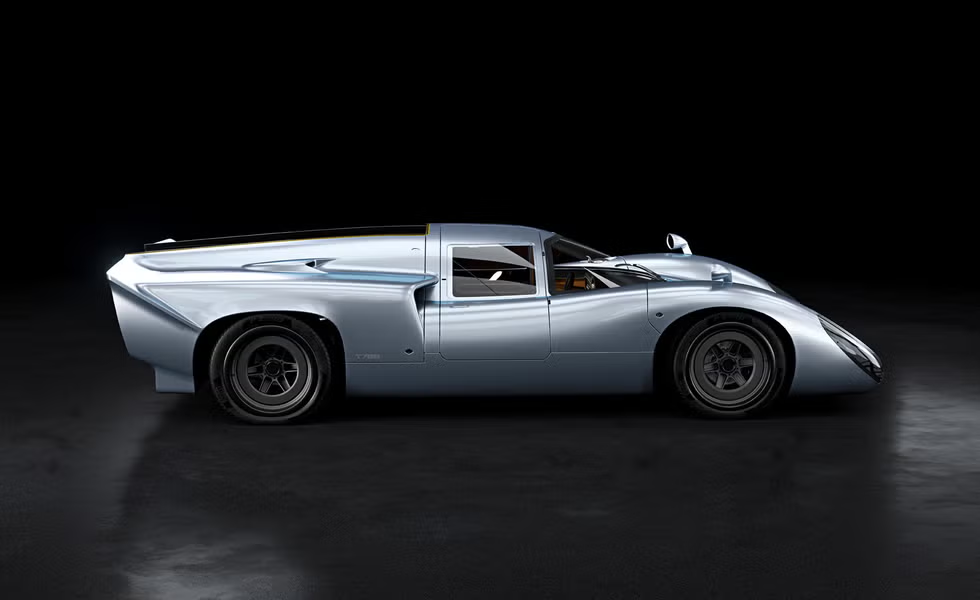
Lola went bust in 2012. A decade later, Till Bechtolsheimer bought the brand, entered Formula E with Yamaha, and started building something the original company never managed: a road car. The T70S GT is a road-legal supercar based on the car that scored a one-two at the 1969 Daytona 24 Hours. Naturally aspirated V8, manual gearbox, bodywork made from plants. Only 16 will be built at Lola’s Silverstone base.
That last detail is worth sitting with for a moment. Sixteen.
The Original T70’s Racing Career
Eric Broadley designed the T70 in 1965 as a weapon for Group 7, the anything-goes prototype class that rewarded raw power and minimal weight. Broadley had already made his name with the Lola Mk6 (the car that caught Ford’s attention and led to the GT40 program), but the T70 was built with a different kind of ambition. He wanted to sell it. Lola built the aluminium monocoque chassis and let privateers drop in whatever American V8 they could find. Chevrolet small-blocks were the popular choice. More than 100 T70s left the factory across three variants: the open-top Mk II Spyder, the Mk III coupe, and the updated Mk IIIB.
The car’s first big win came at Laguna Seca in October 1965 when Walt Hansgen took John Mecom’s Ford-powered T70 to victory at the Monterey Grand Prix. By 1966, the T70 Chevrolet was the hot setup for Can-Am. John Surtees won the championship. Dan Gurney drove the only Ford-powered car ever to win a Can-Am race. The T70 was fast, accessible, and everywhere. Then McLaren showed up with the M6A in 1967 and the Can-Am became Bruce McLaren’s personal playground.
The T70 found its second life in endurance racing. When the FIA changed the rules for 1968, limiting prototype engines to three liters, homologated sportscars with up to five liters were still allowed. That loophole kept the Ford GT40 and the T70 on the grid alongside the new Porsche 908s. At Le Mans in 1967, Lola entered an Aston Martin-powered coupe with Surtees behind the wheel. It was a disaster. The Aston V8 failed after short runs, underdeveloped and underfunded. But the Chevrolet-powered versions kept fighting.
The crowning moment came at the 1969 Daytona 24 Hours. Mark Donohue and Chuck Parsons drove Roger Penske’s Sunoco-liveried T70 to victory, leading a Lola one-two finish ahead of factory Ford GT40s and Porsche 908s. That result remains one of the great privateer upsets in endurance racing history.
The Revival
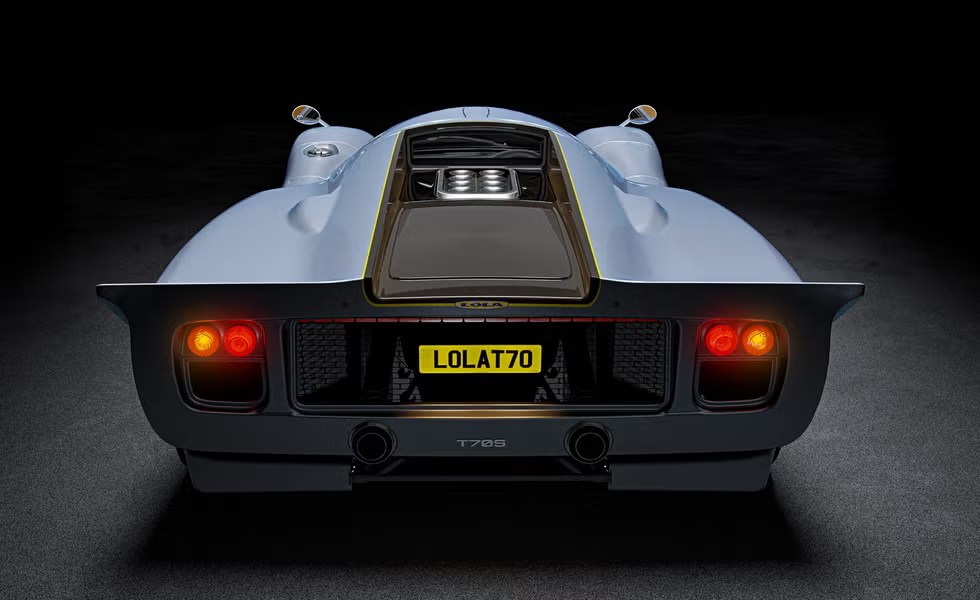
Bechtolsheimer purchased Lola Cars in 2022 and immediately pointed the brand back toward motorsport. The partnership with Yamaha brought Lola into Formula E, and they have since extended their technical collaboration through the Gen4 era beginning in 2026/27. But the T70 project is something else entirely.
Bechtolsheimer was fresh from racing a Ford Mustang GT3 at Sebring when he spoke to Autocar about the car. “I didn’t want this just to be a continuation car,” he said. “I feel like that’s overdone.”
He is not wrong. The continuation and restomod market has become crowded with companies rebuilding famous silhouettes around modern mechanicals. Singer has spent a decade reimagining air-cooled Porsche 911s into half-million-dollar objets d’art. Eagle has evolved from fixing E-Type cooling issues to producing fully re-engineered, alloy-bodied Lightweight GTs weighing under 975 kilograms. RML has shoved LS V8s into short-wheelbase Ferraris. The formula is proven: take a shape people already love, fix what was wrong with it, charge accordingly.
Bechtolsheimer’s pitch is that the T70S GT goes further. The original archive drawings and high-resolution scans of surviving 1960s examples were used to recreate the body, but everything underneath is new engineering. This is not a restored car with better brakes. It is a new car wearing the skin of a legend, and it is the material that skin is made from that separates it from every restomod on the market.
The Body
This is where the story gets genuinely unusual. The bodywork uses what Lola calls the Lola Natural Composite System, or LNCS. Plant waste fibers and basalt rock are bonded with a resin derived from sugarcane processing waste. No petrochemicals anywhere in the mix. Lola claims it is the first 100% natural composite ever used in an automotive application.
The performance data backs up the ambition. LNCS delivers superior tensile strength and stiffness compared to traditional fiberglass composites, with improved impact damage tolerance over both fiberglass and carbon fiber. That last point matters for a car intended to be driven hard. Carbon fiber is strong until it cracks; then it shatters. A natural fiber composite absorbs energy differently, failing more progressively. For a lightweight car with 500 horsepower and no electronic safety nets, that characteristic is more than a talking point.
The Road Car
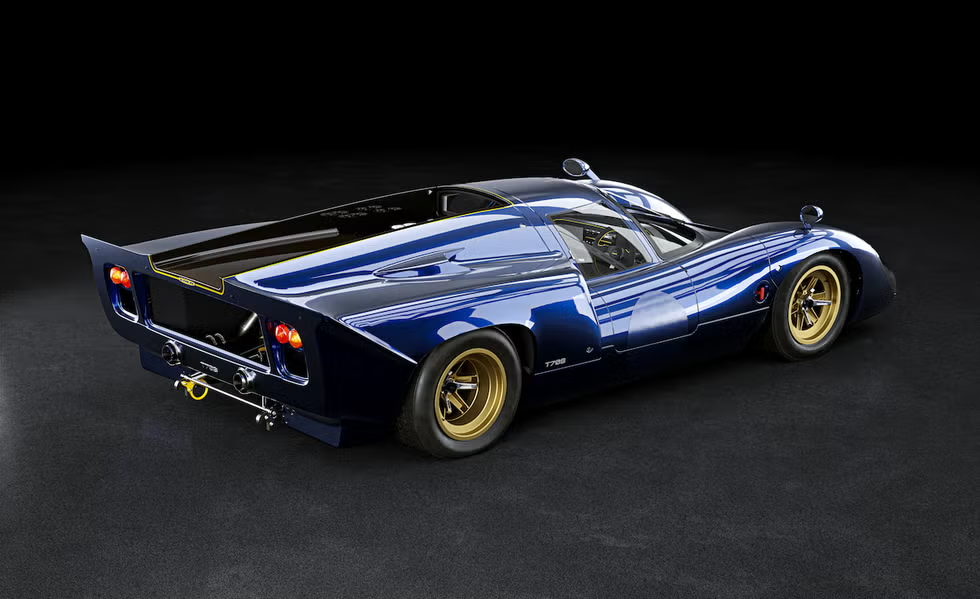
A naturally aspirated 6.2-liter Chevrolet V8 making 500 horsepower. A six-speed Hewland manual gearbox that switches into sequential mode for track use, a dual-personality transmission similar in concept to the Koenigsegg CC850. Aluminium chassis. Double wishbones and height-adjustable coilovers front and rear. Dry weight of 890 kilograms.
The power-to-weight ratio lands at 562 horsepower per tonne. That puts it on par with a Lamborghini Revuelto. 0 to 62 mph in 2.9 seconds. 0 to 124 mph in 9.3 seconds. Top speed of 200 mph.
No screens inside. Analogue dials and controls. Air conditioning, cubbies for headsets, and a small boot for modest luggage are the concessions to road use. The driving position is offset slightly, just like the original, because the transmission tunnel eats into the cabin. There is no power steering, no traction control, no ABS. Every input goes straight through to the mechanicals. The car trusts you. Whether you deserve that trust is your problem.
The Track Car (T70S)
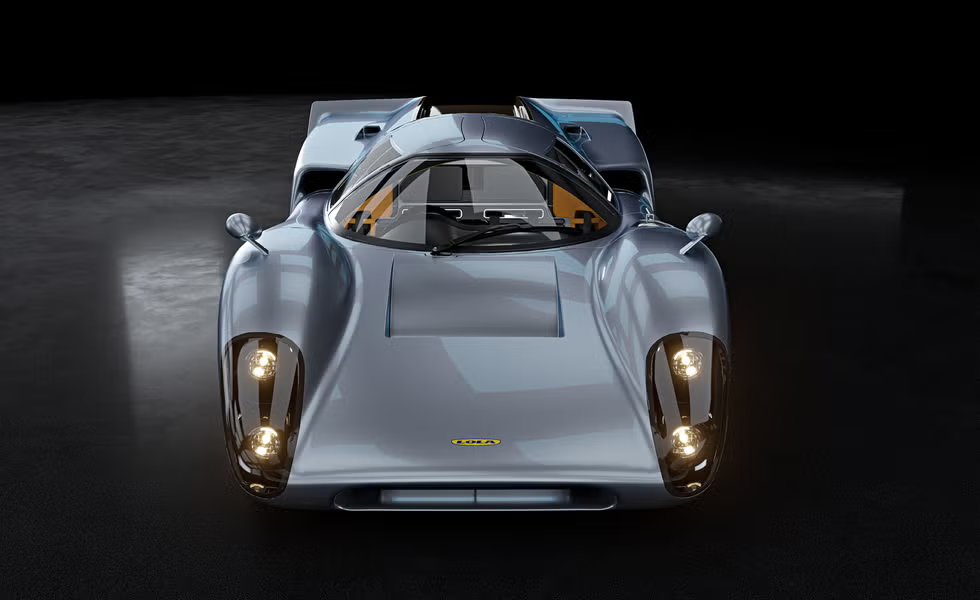
A separate track-only variant runs the original period-correct 5.0-liter Chevrolet V8 making 530 horsepower through a five-speed Hewland. Dry weight drops to 860 kilograms for a power-to-weight ratio of 616 horsepower per tonne. 0 to 62 in 2.5 seconds. Top speed of 203 mph.
Every track car ships with FIA Historic Technical Passport papers, making it eligible for historic racing events worldwide. That is the detail that transforms the T70S from an expensive toy into a competitive weapon. Historic racing grids at Goodwood, Spa, and Le Mans Classic are filled with original T70s worth seven figures. Running one hard means risking irreplaceable metal. A new-build T70S with period-correct specifications and FIA papers lets an owner race a car that belongs on those grids without gambling a piece of history every time it rains at Spa.
The Price
Not announced. Bechtolsheimer positioned it between “what the very best original T70 would be and your base level hypercar.” Original T70s in good condition trade between one and three million dollars depending on provenance. Base level hypercars start around two million. So somewhere in that range.
For context, a Singer DLS starts around $1.8 million. An Eagle Lightweight GT reportedly runs north of $1.5 million. The Lola occupies a different category than either of those cars, but it competes for the same buyer: someone who values mechanical purity, limited production, and a direct connection to motorsport history. The difference is that no Singer or Eagle ever won at Daytona. The T70 did. And this new one can still race for the trophies.
Our Picks

Chemical Guys Car Wash Kit
$50
Shop on Amazon
Blackvue DR770X Dashcam
$280
Shop on Amazon
WeatherTech Floor Liners
$110
Shop on AmazonAs an Amazon Associate, we earn from qualifying purchases.