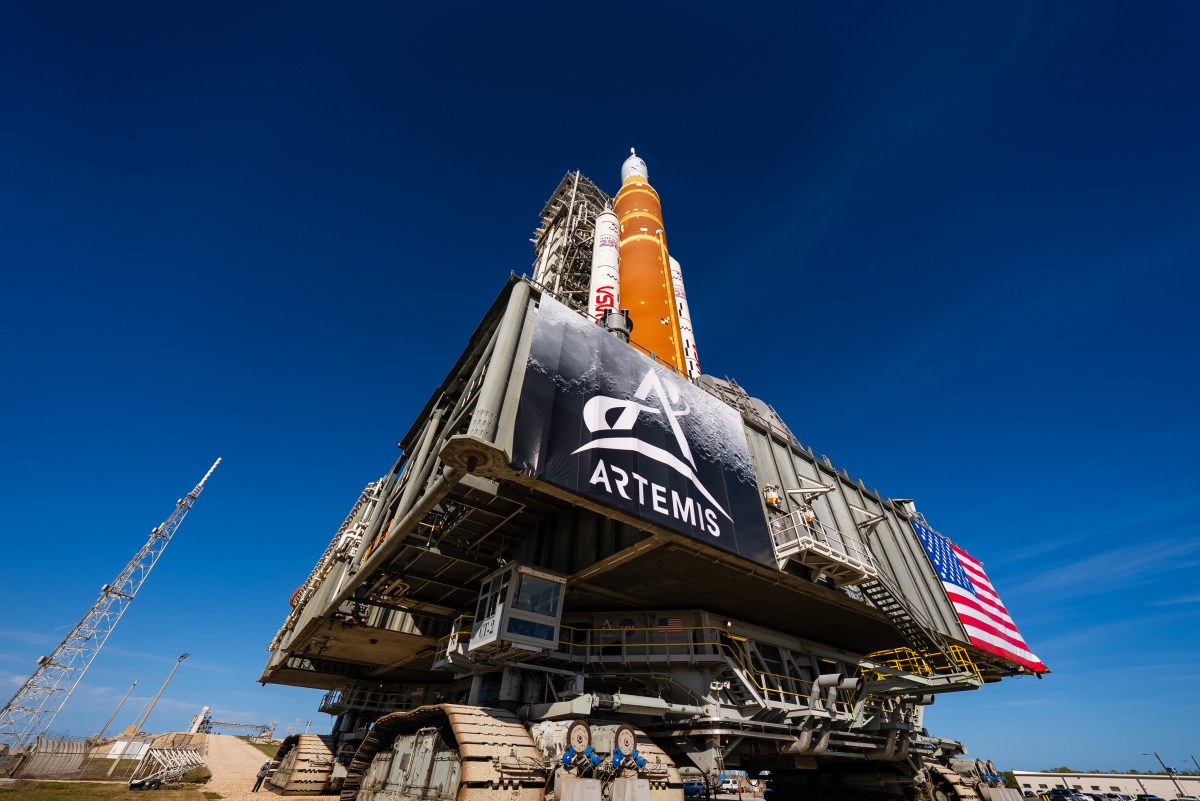
Artemis II Launches Humans Toward the Moon for the First Time in 53 Years
Four astronauts are strapped into the Orion spacecraft at Kennedy Space Center right now, waiting for a 322-foot rocket to throw them toward the Moon at 25,000 miles per hour. The last time humans left low Earth orbit, Richard Nixon was president and the internet did not exist.
Artemis II is NASA’s first crewed lunar mission since Apollo 17 splashed down in December 1972. The launch window opened at 6:24 PM EDT today from Pad 39B, the same concrete slab that has supported 60 launches going back to Apollo 10 in 1969. Fifty-three of those were space shuttles. One of them was Challenger’s last flight. The pad has history pressed into its surface like rings in a tree trunk.
Watch the NASA Broadcast Live
The Crew
Commander Reid Wiseman leads a four-person team that carries the weight of several firsts. Pilot Victor Glover becomes the first person of color to leave low Earth orbit. Mission Specialist Christina Koch becomes the first woman to travel beyond it. Canadian Space Agency astronaut Jeremy Hansen becomes the first non-American citizen to fly to the Moon’s vicinity. Between them, they have logged 660 days aboard the International Space Station and performed 12 spacewalks.
Hansen’s inclusion is particularly notable for what it represents about the Artemis program’s architecture. This is a multinational effort funded by multiple space agencies and bound together by the Artemis Accords. Germany, Argentina, South Korea, and Saudi Arabia all have CubeSat payloads riding along on this mission. Canada built the country’s seat at the table through decades of robotics contributions, from the Canadarm to the Canadarm2 to the Gateway station’s planned robotic systems.
The Mission, Day by Day
The first eight minutes after liftoff are the most dangerous. Two solid rocket boosters and four RS-25 engines (the same engine design that powered every shuttle flight) push the SLS through the atmosphere. The boosters separate just over two minutes in. The core stage shuts down around the eight-minute mark.
Then things get interesting.
After reaching a preliminary orbit, the crew performs something NASA calls “proximity operations.” They manually maneuver Orion around the spent upper stage, approaching within 10 meters of the thing. This simulates future docking procedures with a lunar lander. Howard Hu, NASA’s Orion program manager, put it simply: “We want to make sure we understand our manual capabilities.”
About 25 hours after launch, the Orion service module fires its main engine for the translunar injection burn. That roughly 30-minute firing commits the crew to a free-return trajectory, a figure-eight path that swings around the far side of the Moon and slingshots back toward Earth. Once they’re on that path, turning around becomes harder than staying the course. Emily Nelson, NASA’s chief flight director, noted that after TLI, abort options have “diminishing returns.” The physics of the free-return trajectory are, in a sense, the safest option available.
Day six is the centerpiece. Orion passes within 4,000 to 6,000 miles of the lunar surface. The Moon fills the windows, roughly the size of a basketball held at arm’s length. The crew gets about three hours of closest-pass observations: photography, geological tracking, data collection. They swing around the far side, temporarily losing contact with Earth, and depending on the exact launch date within the window, they could break Apollo 13’s record for the greatest distance from Earth ever achieved by humans. That record currently stands at roughly 248,655 miles. Artemis II’s trajectory could push past 252,000.
The return trip includes radiation shielding demonstrations (the crew practices sheltering behind water tanks and the heat shield itself), attitude control tests, and a spaceflight first: a real-time audio call between the Orion crew and the astronauts aboard the International Space Station. Two crewed outposts, occupied simultaneously, separated by hundreds of thousands of miles and connected by voice. That has never happened before.
The Heat Shield Question
Here is the part of the mission that generated the most debate in the aerospace community.
During Artemis I, the uncrewed test flight in 2022, engineers discovered unexpected erosion on Orion’s AVCOAT ablative heat shield. Chunks of the protective material charred and broke away in patterns that didn’t match predictions. NASA spent over a year investigating. The conclusion: rather than redesigning the heat shield for Artemis II (which would have added years of delay), NASA modified the reentry trajectory. They eliminated the planned “skip reentry” in favor of a steeper, more direct atmospheric entry that reduces the total heat load on the shield.
NASA Administrator Jared Isaacman reviewed the data and approved the decision. Not everyone agreed. Several former engineers and astronauts publicly questioned the call, arguing that flying a known-flawed heat shield design (even with a modified trajectory) carried unacceptable risk. The reentry speed will hit approximately 25,000 mph, generating temperatures around 3,000 degrees Fahrenheit on the shield’s surface. That is the fastest reentry speed ever attempted with humans aboard.
NASA’s position is that the modified trajectory keeps thermal loads within the shield’s demonstrated capabilities. The full heat shield redesign begins with Artemis III. Kirk Shireman, Lockheed Martin’s VP for the Orion program, emphasized that life support is the other major focus: “The big emphasis will be on environmental control and life support systems.” Commander Wiseman put it more bluntly: “Can it scrub our carbon dioxide? Can it keep us alive? Can we drink water? Can we go to the bathroom?”
Fair questions when you’re 250,000 miles from the nearest hospital.
Launch Day Drama
Because space refuses to be boring, today’s countdown hit a snag with roughly two hours remaining. The Flight Termination System, the Eastern Range safety mechanism that sends a self-destruct signal if the rocket veers off course, flagged an issue. The launch director sent a console operator to the Vehicle Assembly Building to locate a piece of “heritage equipment” from the space shuttle program to help verify troubleshooting. Shuttle-era hardware, solving problems on a Moon rocket in 2026. The space industry has a long memory when it needs one.
The crew boarded Orion around 2:30 PM, riding to the pad in the Astrovan II, a modified Airstream Atlas Touring Coach leased from Boeing. NASA originally planned to use custom electric vans from Canoo Technologies for crew transport. Then Canoo went bankrupt. So the astronauts headed to humanity’s return to deep space in a borrowed motorhome. There’s something honest about that.
Before entering the capsule, each crew member signed their name on the wall of the “white room,” the clean access area at the top of the launch tower. That tradition goes back to the Gemini program in the 1960s. The spacesuits themselves were custom-built by the David Clark Company in Worcester, Massachusetts. Each one can sustain its wearer for up to six days if the cabin loses pressure.
What Comes Next
If Artemis II succeeds, Artemis III targets mid-2027 for the first crewed lunar landing since 1972. That mission would put boots on the Moon’s south pole, a region no human has ever visited.
The 10-day flight (technically 9 days, 1 hour, and 46 minutes, but NASA rounds up) ends with splashdown in the Pacific Ocean off the coast of San Diego. Three main parachutes slow Orion to 17 miles per hour before it hits the water. A U.S. Navy recovery ship retrieves the crew and capsule. After that, the astronauts face something charmingly mundane: an obstacle course designed to measure how quickly they readjust to gravity, followed by a simulated spacewalk to test post-flight motor function.
Fifty-three years is a long time between trips. The people who watched Apollo 17 land are grandparents now. Some of them are gone. The technology, the geopolitics, the economics of spaceflight: everything has changed. What hasn’t changed is the fundamental absurdity of strapping four people to a controlled explosion and pointing them at a rock 250,000 miles away, trusting math, engineering, and human nerve to bring them home.
The window is open. The rocket is fueled. The countdown continues.
Our Picks
Away Carry-On
$275
Shop on Amazon
Osprey Farpoint 40
$185
Shop on Amazon
Peak Design Packing Cube
$45
Shop on AmazonAs an Amazon Associate, we earn from qualifying purchases.